 Blog
Blog

As a native-born Israeli, Nati is happy to tell you more about Jewish holidays, traditions and special customs. In this blog, he takes you on a journey through Sukkot, the Jewish Feast of Tabernacles. During this special festival, Jewish people build a sukkah, a temporary hut where they eat, drink and spend time with family and friends. Sukkot commemorates the forty years during which the Israelites wandered through the wilderness after the Exodus from Egypt and lived in temporary dwellings. At the same time, it is a festival of gratitude for the harvest, hospitality and togetherness. In Leviticus 23:42–43, this tradition is described: “For seven days you are to live in shelters [...] so your descendants will know that I had the Israelites live in shelters when I brought them out of Egypt. I am the LORD your God.”
What Is Sukkot?
Sukkot, also known as the Feast of Tabernacles, is one of the three biblical pilgrimage festivals in Judaism. In Israel, the festival lasts seven days. Sukkot begins each year on the 15th day of the Jewish month of Tishrei. Outside Israel, Sukkot is traditionally observed for eight days. The first day of Sukkot is a Yom Tov, a holy day on which, among other things, work is not permitted and candles are traditionally lit. At the beginning of the festival, Kiddush is recited, a blessing over wine.
The days in between are known as Chol HaMoed. These are festival days with a less strict character, during which many everyday activities are permitted. After the seven days of Sukkot comes Shemini Atzeret, a separate holiday that immediately follows Sukkot. In Israel, Simchat Torah is also observed on this day. Outside Israel, Shemini Atzeret and Simchat Torah are generally observed as two separate days.
Customs During Sukkot
One of the best-known customs during Sukkot is building a sukkah, a temporary hut. During the festival, meals are eaten there and time is spent with family and friends. Some people also sleep there, depending on their tradition, the weather and their personal circumstances. The sukkah recalls the temporary dwellings of the Israelites during their journey through the wilderness. The hut therefore symbolizes the temporary nature of life and trust in God.
For at home
With Osem Bissli BBQ 70g, you can enjoy a uniquely Israeli snack. Bissli is a crunchy wheat snack made in the shape of pasta. This is a uniquely Israeli product!
Osem Bamba with hazelnut filling (nougat) 60g contains no preservatives or food coloring and is enriched with several vitamins. A delicious Israeli snack that is also great for babies.
Goldstar Lager Beer is a well-known Israeli beer and a great choice to enjoy at home or with friends.
What Does a Sukkah Look Like?
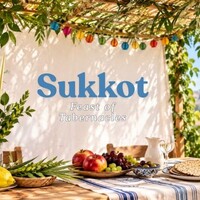
A sukkah is a temporary hut built according to specific rules. It must have at least three walls and an opening as an entrance. The walls can be made from different materials, as long as the structure is sturdy enough. The most distinctive part is the roof, known as s'chach. This must be made from natural material that has been cut from the ground, such as branches, leaves or reeds. The roof should provide enough shade, while still leaving openings through which the sky can be seen.
A sukkah is often decorated with garlands, drawings, fruit and other decorations. The aim is to turn the temporary hut into a beautiful and welcoming place where family and guests feel welcome.
The Feast of Ingathering
In the Bible, Sukkot is also associated with the Feast of Ingathering. It takes place at the end of the agricultural year, when the harvest has been gathered in. Sukkot is therefore also a festival of gratitude. The harvest had been brought in, allowing people to look back on the agricultural year that had passed. This also explains why fruit, branches and other natural products play such an important role during the festival.
How Is Sukkot Celebrated?
After Yom Kippur, many Jewish families begin building and decorating their sukkah. In Israel, you see many temporary huts appearing during this period: on balconies, in gardens and in other suitable places. An important mitzvah during Sukkot is to eat in the sukkah and spend time there. For some people, this means having as many of their meals as possible in the sukkah throughout the festival. Others also sleep there. Hospitality is another important part of Sukkot. According to a well-known Jewish tradition, the Oshpizin, the symbolic guests, are welcomed into the sukkah. These are seven important figures from Jewish history: Abraham, Isaac, Jacob, Moses, Aaron, Joseph and David. According to tradition, each day of Sukkot is symbolically associated with one of these guests. The idea behind the Oshpizin fits beautifully with the importance of hospitality during Sukkot. The sukkah is not meant to be a place just for yourself and your family, but especially a place where others are welcome.
What Are the Four Species?
Another important Sukkot custom is the use of the Four Species, known in Hebrew as Arba'at HaMinim. These are four types of plants:
- Lulav – a closed palm frond
- Etrog – a citrus fruit resembling a large lemon
- Hadas – at least three sprigs of myrtle
- Aravah – at least two willow branches
The four species are bound together and waved at specific points during the prayers. This is accompanied by a blessing and expresses the special significance of Sukkot. The Four Species are traditionally also understood as a symbol of the different qualities of people within the Jewish community. In this interpretation, taste and fragrance are considered. The etrog has both taste and fragrance. It therefore represents people who both study the Torah and perform good deeds. The lulav, referring here to the palm frond, has taste but no fragrance. It symbolizes people who study the Torah but place less emphasis on good deeds. The hadas, or myrtle, has fragrance but no taste. It represents people who perform good deeds but spend less time studying the Torah. The aravah, or willow, has neither a distinctive taste nor fragrance. It symbolizes people who, according to this interpretation, neither study the Torah nor perform many good deeds.
The symbolism of the Four Species shows that everyone within the community has their own place and value. By bringing the four species together, a whole is created in which the different qualities complement one another.
Sukkot: A Festival of Remembrance, Gratitude and Hospitality
For Nati, Sukkot is a beautiful example of how Jewish traditions connect history with everyday life. In Israel, you see sukkot appearing everywhere during this period: at people’s homes, on balconies and in other places where there is enough space to build a temporary hut. What began as a reminder of the Israelites’ journey through the wilderness has grown into a festival centered around remembrance, gratitude, hospitality and togetherness. Precisely because Sukkot encourages you to literally step outside your normal home for a while, it reminds you that a home and all the certainties of everyday life should never be taken for granted.